

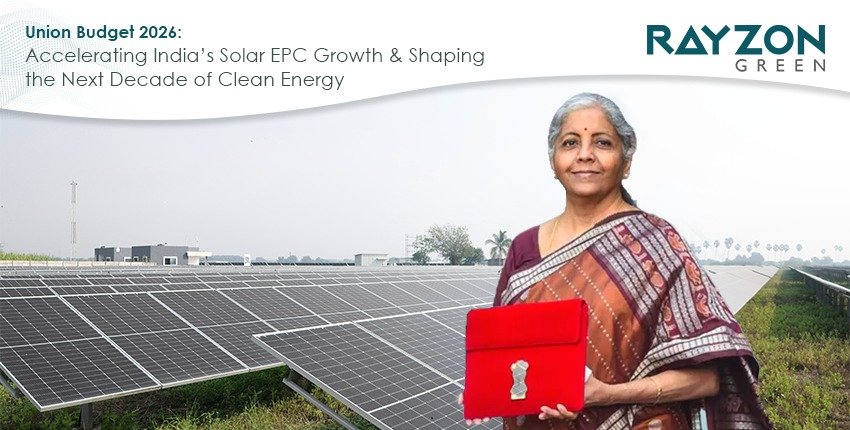
As India approaches Union Budget 2026, the renewable energy sector stands at a defining crossroads. With rising electricity demand, accelerating industrial growth, and firm climate commitments, the coming budget is expected to influence not only policy direction but also the pace and scale of infrastructure execution.
For the solar EPC (Engineering, Procurement, and Construction) sector, Budget 2026 is more than an annual fiscal exercise—it is a strategic inflection point. At Rayzon Green, we see this moment as an opportunity to strengthen execution ecosystems, unlock large-scale solar deployment, and build future-ready energy infrastructure that supports India’s long-term growth.
India’s electricity demand is projected to grow at 5–6% annually through the end of the decade, driven by industrial expansion, urbanization, electric mobility, and digital infrastructure. Peak power demand has already crossed 240 GW, and projections suggest this could exceed 300 GW by 2030.
To meet this demand sustainably, India has committed to achieving 500 GW of non-fossil fuel capacity by 2030, with solar power expected to contribute nearly 280–300 GW. As of 2025, installed solar capacity is estimated at 85–90 GW, meaning over 190 GW of additional solar capacity must be built in less than five years.
This scale of expansion places solar EPC companies at the center of India’s energy transition.
Over recent years, government spending on clean energy and power infrastructure has steadily increased. In Budget 2025, combined allocations for renewable energy, grid expansion, and green corridors exceeded ₹35,000 crore.
Market expectations for Budget 2026 include:
For solar EPC players, such fiscal clarity directly translates into stronger project pipelines, improved bankability, and faster execution cycles.
While targets and budgets define intent, actual progress depends on execution. To achieve annual installations of 35–40 GW of solar capacity, India will require:
Budget 2026 is expected to strengthen EPC execution indirectly by:
For experienced EPC companies like Rayzon Green, this environment enables long-term planning, investment in skilled manpower, and adoption of advanced construction technologies.
By 2026, utility-scale solar is expected to account for 70–75% of annual solar additions, equivalent to 25–30 GW per year. States such as Rajasthan, Gujarat, Maharashtra, Karnataka, and Tamil Nadu will continue to lead this expansion due to high solar irradiation and improving infrastructure.
This scale of deployment is reshaping EPC requirements:
Rayzon Green’s EPC model is aligned with these demands, focusing on engineering precision, execution reliability, and lifecycle performance.
India remains one of the world’s most attractive renewable energy markets. In recent years:
Budget 2026 is expected to further strengthen financing sentiment through policy stability and continued emphasis on green finance. For EPC companies, this results in:
A stable investment environment allows EPC players to focus on execution excellence rather than uncertainty management.
As solar capacity scales, grid infrastructure becomes a critical enabler. India plans to add over 50,000 circuit kilometers of transmission lines by 2030, with a significant portion linked to renewable evacuation.
Budget 2026 is expected to prioritize:
For solar EPC companies, improved grid readiness reduces commissioning delays and enhances project performance predictability.
India’s focus on domestic manufacturing is reshaping the solar supply chain. Current domestic solar module manufacturing capacity exceeds 60 GW, with further expansion underway.
A stronger domestic ecosystem offers EPC companies:
Budget 2026 is expected to continue supporting domestic manufacturing, strengthening long-term supply-chain resilience and execution confidence.
As solar penetration increases, flexibility and grid stability become increasingly important. Energy storage and hybrid configurations are expected to gain momentum post-2026.
Industry projections indicate:
For EPC companies, this evolution means greater engineering complexity and deeper system integration—areas where experience and technical depth matter.
For Rayzon Green, Union Budget 2026 aligns closely with our long-term vision:
As project sizes increase and timelines compress, execution reliability becomes the most valuable differentiator—one that remains central to our approach.
With more than 190 GW of solar capacity yet to be built by 2030, the coming years will define India’s renewable energy future. Budget 2026 has the potential to act as a growth multiplier—aligning policy, capital, and infrastructure to accelerate deployment at scale.
For the solar EPC sector, this phase represents responsibility as much as opportunity. Translating ambition into operational assets will require engineering excellence, disciplined execution, and long-term thinking.
Union Budget 2026 is poised to play a pivotal role in shaping India’s clean energy trajectory. By reinforcing financial support, enabling infrastructure readiness, and strengthening investor confidence, the budget can unlock the next phase of solar growth.
As India advances toward its renewable goals, Rayzon Green remains committed to powering this transition through engineering-led EPC solutions, scalable execution, and a relentless focus on quality and sustainability—helping build an energy future that is resilient, reliable, and ready for the decade ahead.