
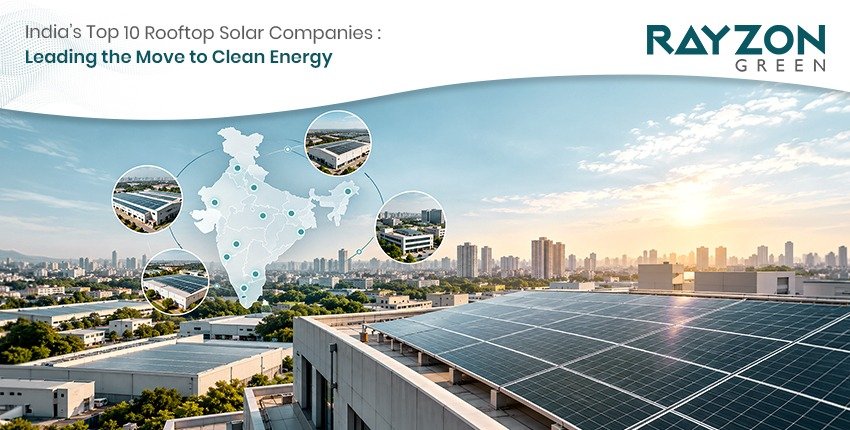
Electricity bills in India keep going up every year. Whether you are in charge of a factory that runs machines all the time manage a warehouse or just want to stay cool in your home during hot summer days the cost of power is taking a big chunk of your money.
At the time roofs all over the country are not being used. They sit empty under the sun.
That difference is why rooftop solar has become very popular in India. In a few years the number of rooftop solar installations went from less than 2 GW in 2019 to more than 17 GW by 2025. The country is expected to reach 30 GW by 2027. What was once considered a special green idea is now one of the financial choices for a homeowner or a business owner. With government help like the PM Surya Ghar: Muft Bijli Yojana and simple savings on your electricity bill that pay for the system in a few years solar energy has become something that makes sense.
Putting up a solar power system on your roof is not like buying a home appliance. A rooftop solar system is like a power plant that has to work safely and give steady power in very hot weather, heavy rain and a lot of dust for 25 years or more. To get the savings you want you need the tools and the right team to install it.
That is why expert teams in Engineering, Procurement and Construction are needed. Companies like Rayzon Green take care of everything from checking the roof and designing the system to dealing with the electricity board and providing long-term support.
In this guide we explain how rooftop solar works, how to pick the company and who the top 10 rooftop solar companies, in India are today.
Why Is Rooftop Solar Booming Across India?
The rapid switch to rooftop solar is not happening by accident. It is being powered by three simple realities: direct financial savings, strong government support, and reliable modern equipment.
Commercial and industrial businesses in India pay some of the highest power rates in the world, often between ₹7.50 and ₹11.50 per unit (kWh). When power accounts for 30% to 50% of your operational costs, every single unit matters. Generating your own power from your rooftop brings that cost down to around ₹2.50 to ₹3.50 per unit over the life of the system.
Because the savings are so immediate, most factory and office rooftop systems fully recover their initial cost within 3 to 4 years. After that, the system produces essentially free electricity for the remaining 20-plus years of its working life.
For residential homeowners, the Central Government launched the PM Surya Ghar: Muft Bijli Yojana through the Ministry of New and Renewable Energy (MNRE). This initiative offers direct bank-account subsidies that take a huge burden off the initial setup cost:
With ₹78,000 shaved off a typical 3 kW to 5 kW home installation, ordinary households can wipe out 80% to 100% of their monthly electric bills while breaking even in just 3 to 4 years.
Solar panels produce the most power in the middle of the day when the sun is brightest. But what if your factory or home does not use all that power right away?
Thanks to state net metering rules, excess solar power flows backward into the main power grid. Your bi-directional energy meter runs in reverse, giving you power credits on your monthly bill. When you pull power from the grid at night, those credits offset your usage, ensuring that not a single ray of sunshine goes to waste.
Many people assume going solar just means buying panels and bolting them to a roof. In reality, panel hardware is only one piece of the puzzle. If the civil structures are weak, the wiring is loose, or the local utility rejects your net meter application, your investment will stall.
This is why working with an end-to-end solar EPC company like Rayzon Green is so important. EPC stands for Engineering, Procurement, and Construction. Here is what a full-service EPC provider handles on your behalf:
Whether you are looking for an all-in-one EPC partner to manage your project or wanting to understand who manufactures the most reliable hardware, here are the top 10 rooftop solar companies leading India’s clean energy movement.
When businesses and homeowners decide to go solar, their biggest concern is usually project execution: Who will deal with the power board? Will my roof leak? What happens if an inverter stops working?
Rayzon Green solves these problems by acting as a dedicated, full-service clean energy partner. As the specialized turnkey EPC arm within the wider Rayzon group, Rayzon Green manages the entire journey from the initial structural roof check to final grid commissioning and long-term cleaning.
What makes Rayzon Green stand out is their complete, client-first approach:
For anyone looking for a reliable, experienced EPC contractor that takes full ownership of design, safety, paperwork, and long-term performance, Rayzon Green is one of the most capable names in the country today.
Tata Power's solar arm remains the most recognized name in Indian rooftop solar, and for good reason - it combines the trust of the Tata brand with genuine execution scale. The company has reported more than 5,19,673 rooftop installations and over 5.3 GWp of cumulative rooftop capacity as of August 2026, spanning residential, C&I, and solar-plus-battery offerings. Its biggest strength is reach - a pan-India dealer and service network that smaller EPC players simply can't match, backed by financing tie-ups that make it a default choice for homeowners applying under PM Surya Ghar
Waaree is one of India's largest solar module manufacturers, and its integrated model - manufacturing plus EPC - lets it serve everything from a small MSME rooftop to a utility-scale ground-mount project. For C&I buyers in particular, Waaree's high-efficiency PV modules and rooftop-to-utility-scale solutions make it a bankable choice when a project needs financing from a nationalized bank, since lenders are comfortable with its listed-company financials and manufacturing scale
Backed by Adani Group's balance sheet and logistics network, Adani Solar has scaled rapidly as one of India's biggest integrated solar manufacturers and suppliers active across the utility and rooftop segments. It's less of a boutique rooftop installer and more of a volume play - the go-to when a large industrial group needs bulk module procurement alongside EPC execution, particularly for sprawling factory or warehouse rooftops that need hundreds of kilowatts installed on a tight timeline.
Kolkata-headquartered Vikram Solar built its reputation on module quality and export credentials before expanding into ground-mounted and rooftop EPC. It's a strong fit for industrial buyers who prioritize module bankability - tier-1 certification, strong degradation warranties - over the lowest sticker price, and its high-efficiency PV modules for ground-mounted and rooftop EPC continue to feature in large commercial installations across eastern and western India.
Premier Energies has emerged as one of India's fastest-scaling solar cell and module manufacturers, with a focus on Mono PERC and TOPCon solar cells and modules. While it's historically been a manufacturing-first player supplying modules to EPC contractors, its growing presence in industrial and utility-scale rooftop projects reflects the broader shift among Indian manufacturers to move closer to the end customer rather than just supplying panels
Another Surat-based manufacturer, Goldi Solar has built a strong regional footprint in Gujarat's residential and commercial rooftop segment. It's a recognizable name for homeowners and small business owners in the state who want a locally headquartered brand with an established dealer network, and it continues to expand its module manufacturing capacity to keep pace with demand from EPC partners across western India.
Loom Solar has carved out a genuinely different position from the rest of this list - it's a direct-to-consumer brand built around plug-and-play modules and inverter-plus-panel bundles sold largely online. For homeowners who want to DIY-install a small rooftop system or work with a local electrician rather than a full-service EPC contractor, Loom has become one of the most searched rooftop solar brands in the residential segment.
Freyr Energy is a Hyderabad-based turnkey rooftop installer that has built its business specifically around residential and MSME rooftop execution, reporting 12+ years of operation, 20,000+ customers, and 150+ MW installed across six named states. Its value proposition is coordination - homeowners and small business owners often struggle to manage vendor selection, DISCOM paperwork, and net-metering approvals on their own, and Freyr positions itself as the single point of contact for that entire journey.
Fourth Partner Energy is one of India's most established C&I rooftop specialists, built almost entirely around the RESCO/OPEX model - where the company owns, finances, and maintains the solar system on a client's rooftop, and the client simply pays for the electricity it consumes at a discounted per-unit rate. This zero-capex approach has made it a preferred partner for large retail chains, warehousing companies, and manufacturing groups that want the savings from solar without tying up capital or taking on O&M responsibility.
Before you sign a solar contract, keep these practical checkpoints in mind:
This is exactly the gap companies like Rayzon Green are built to close for industrial clients across Gujarat and Maharashtra - combining EPC execution with manufacturing-backed supply chains and long-term O&M support, rather than treating a rooftop installation as a one-time transaction
Three forces are converging to push rooftop solar from optional to obvious for Indian businesses and households alike.
Policy momentum. The PM Surya Ghar scheme has fundamentally changed the economics of residential rooftop solar, and its ripple effects extend to the commercial segment too - as more vendors get registered and trained under the scheme (MNRE reported 34,219 registered vendors, including 29,469 active vendors, as of mid-2026), the overall rooftop EPC ecosystem has matured, with better-trained installers, faster approval timelines, and more competitive pricing across both residential and C&I segments.
Rising grid tariffs. Commercial and industrial power tariffs in states like Gujarat and Maharashtra have climbed steadily, while solar module costs have fallen over the past several years. That crossover point - where rooftop solar generates power cheaper than the grid — has already been crossed for most C&I consumers, which is why factory owners increasingly see solar as a cost-control decision rather than a sustainability nice-to-have.
Financing innovation. The old barrier to industrial rooftop solar - a large upfront capital outlay - has largely dissolved. CAPEX ownership still makes sense for companies with available capital and a long investment horizon, but OPEX/RESCO and group captive models now let businesses go solar with zero or minimal upfront cost, paying only for the power they use. This shift in financing structure, more than any single technology improvement, is what's driving the current wave of industrial rooftop adoption.
India’s clean energy shift is no longer a distant vision for the future—it is happening right now on factory sheds, office buildings, and residential rooftops across the country.
Installing rooftop solar cuts your electricity expenses, protects your business against future utility rate hikes, and noticeably reduces your carbon footprint. With proven hardware, dependable 25-year performance warranties, and quick 3-year payback periods, the returns are both reliable and significant.
The key to getting those results lies in choosing an experienced partner who understands the complete picture-from engineering and safety to government paperwork and long-term care.
If you are ready to stop paying inflated power bills and turn your empty roof into a high-yielding clean energy asset, connect with the team at Rayzon Green. Explore their turnkey solar EPC solutions and learn how their engineering experts can design a high-efficiency rooftop system tailored specifically to your needs.
There's no single "best" - it depends on your rooftop type, project scale, and financing preference. Companies with dedicated C&I execution experience, like Fourth Partner Energy and Rayzon Green, tend to be better suited to industrial-scale projects than brands built primarily for residential rooftops.
Costs vary by system size, module technology, and state, but industrial-scale rooftop systems generally see lower per-kW costs than small residential systems due to economies of scale. It's best to get a site-specific quote, since structural, shading, and grid-connectivity factors all affect final pricing.
PM Surya Ghar's direct subsidy is designed for residential consumers, offering financial assistance for systems up to 3 kW (with partial support up to 10 kW for group housing). Commercial and industrial rooftop projects generally don't qualify for this residential subsidy but benefit instead from accelerated depreciation, net-metering policies, and, in many cases, more favorable long-term economics through OPEX financing models.
For most C&I consumers facing high grid tariffs, yes - rooftop solar typically pays back within 3-5 years under a CAPEX model and offers immediate savings with zero upfront cost under an OPEX/RESCO structure. The bigger question isn't whether it's worth it, but which financing model and EPC partner fit your specific operation.
Under CAPEX, the business owns the solar system outright, pays the full installation cost upfront (or via loan), and keeps 100% of the savings once payback is achieved. Under OPEX/RESCO, a developer owns and maintains the system on your rooftop, and you simply pay a discounted per-unit electricity rate - no upfront capital, but a smaller net saving over the system's lifetime compared to full ownership.