

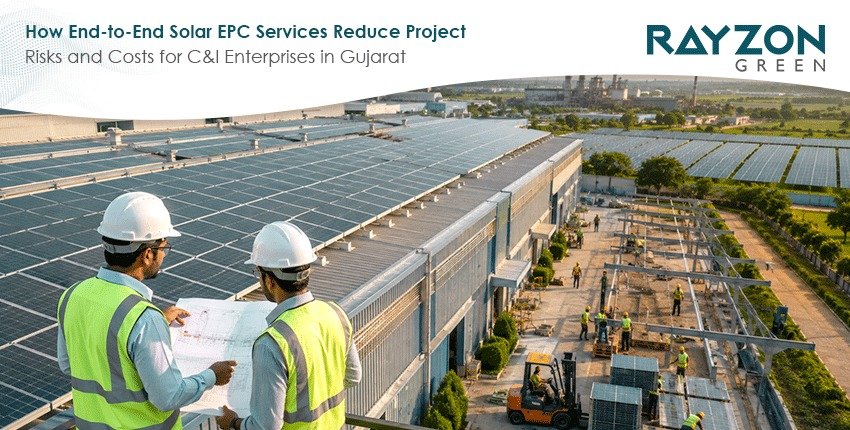
India's renewable energy capacity reached a historic milestone by surpassing 100 GW of total installed solar capacity, establishing a solid foundation for the national ambition of achieving 500 GW of non-fossil fuel power by 2030. Within this national expansion, the state of Gujarat has cemented its status as the nation's primary solar engine, deploying over 1,649 MW of rooftop solar capacity in a single fiscal year—the highest total among all Indian states. For commercial and industrial (C&I) enterprises operating across prominent manufacturing corridors such as Surat, Vadodara, Bharuch, Vapi, and Ahmedabad, adopting solar photovoltaic (PV) power is no longer merely an environmental initiative; it is a vital operational strategy to hedge against rising grid tariffs and secure long-term energy cost predictability.
However, executing industrial rooftop or utility-scale ground-mounted solar projects involves managing complex engineering variables, volatile supply chains, and evolving regulatory mandates. Businesses that attempt to manage solar projects using a multi-vendor approach—engaging separate structural design consultants, third-party component distributors, local civil contractors, and independent regulatory liaison agencies—frequently experience compounding schedule delays, cost overruns, and lower operational performance over the asset's lifetime. End-to-end Solar Engineering, Procurement, and Construction (EPC) services address these challenges by consolidating the entire project life cycle under a single point of operational accountability. Rayzon Green, headquartered in Surat, Gujarat, leverages a vertically integrated turnkey EPC model designed to de-risk project delivery and optimize the Levelized Cost of Energy (LCOE) for C&I clients and utility-scale solar developments across India.
EPC stands for Engineering, Procurement, and Construction - but in solar, it's really a shorthand for everything that happens between "we've decided to go solar" and "the plant is generating clean, reliable power for the next two and a half decades.
Good EPC isn't just about putting panels on a rooftop or ground-mounting them in a field. It includes:
Engineering that accounts for the specific site — its soil, its shading patterns, its grid connection point, its future expansion possibilities
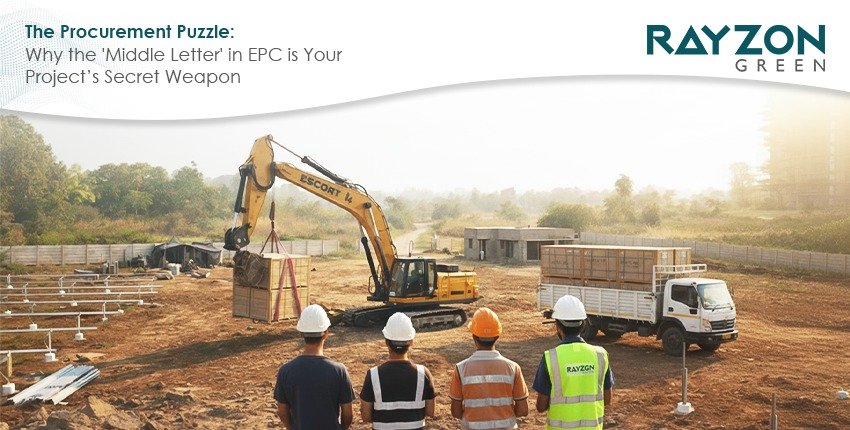
Procurement that sources components built to last, not just components that meet the lowest quote
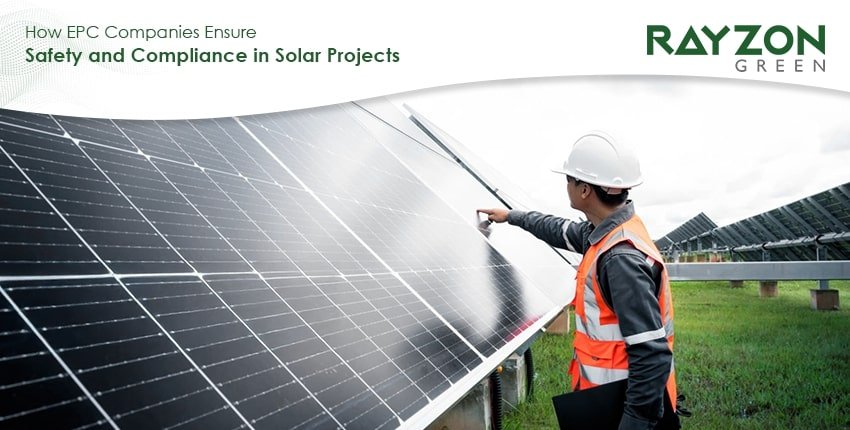
Construction that follows safety and quality standards even when no one's watching
Commissioning that actually tests the system under real conditions before handing over the keys
Support after handover-because a plant's real test isn't the day it switches on, it's the fifth monsoon it survives
When any one of these steps is rushed or under-resourced, the effects don't show up immediately. They show up two years later, in the form of underperformance, unexpected repairs, or a plant that quietly generates 15% less than it should — every single day, for the rest of its life.
Most execution failures in Indian solar projects aren't dramatic. They're small, avoidable decisions that compound over time.
A cable routed without enough protection from rodents or rainwater. A tracker system installed without properly accounting for wind loads in the region. A transformer sized for today's load but not tomorrow's expansion. A commissioning team that signs off on paperwork without physically verifying every string.
None of these mistakes look like much on the day they happen. But add them up across a 20-25 year plant life, and they become the difference between a project that pays for itself on schedule and one that becomes a slow-burning financial disappointment for the buyer.
This is also why so many solar buyers -especially industrial and commercial ones - have grown more cautious. They've seen enough plants underperform to know that a low upfront quote can quietly become a much higher long-term cost.
Turnkey solar EPC mitigates operational, financial, and technical vulnerabilities across every phase of system execution:
|
Risk Vector |
Fragmented Multi-Vendor Sourcing |
Rayzon Green Turnkey EPC Solutions |
Operational and Financial Advantage |
|
Engineering Design |
Disconnect between structural design and electrical layout causing mismatch losses and thermal hotspots. |
In-house 3D shading simulations, load assessments, and optimized inverter-to-module ratio engineering. |
Prevents 10%–20% annual yield losses and avoids structural roof damage risks. |
|
Supply Chain & Procurement |
Susceptible to shipping delays, import tariffs, price volatility, and unverified module degradation. |
Direct access to internal ALMM-compliant N-Type TOPCon modules from Gujarat manufacturing units. |
Eliminates supply chain markups, guarantees Tier-1 hardware quality, and ensures delivery timelines. |
|
Construction & Safety |
Uncoordinated contractors leading to non-compliant earthing, poor cable management, and wind-load vulnerabilities. |
Certified civil/electrical construction following strict BIS, CEA, and local safety protocols. |
Eliminates electrical fire risks, structural failures, and safety non-compliance penalties. |
|
Regulatory Grid Approval |
Split responsibilities causing prolonged delays in DISCOM inspection, CEI approvals, and net metering activation. |
Turnkey management of GEDA, DISCOM portal registrations, TFR clearances, and commissioning certificates. |
Accelerates grid synchronization from several months to a few weeks, avoiding lost generation income. |
|
Post-Commissioning Warranties |
Split warranties across panel, inverter, and balance-of-plant vendors leading to dispute delays during downtime. |
Unified single-point performance guarantee and structured Annual Maintenance Contracts (AMC). |
Streamlines warranty resolution and maintains higher plant uptime over 25 years. |
Integrated turnkey execution optimizes the complete financial lifecycle of commercial solar investments:
|
Financial Parameter |
Conventional Multi-Contract Execution |
Integrated Turnkey EPC Framework |
Financial Result |
|
Balance of Plant Procurement |
Retail distributor pricing with multi-layered intermediary markups. |
Institutional bulk sourcing and direct manufacturing synergies with Rayzon Solar. |
Direct 8% to 15% reduction in initial capital expenditure. |
|
Project Execution Schedule |
Average 3 to 6 months of execution delay due to vendor coordination friction. |
Fixed-timeline delivery backed by milestone tracking and single-point project management. |
Eliminates extended interest during construction and secures immediate utility bill savings. |
|
Long-Term Operations & Maintenance |
Reactive repairs, slow diagnostic response times, and higher spare parts overhead. |
Continuous SCADA diagnostics, automated performance alerts, and structured AMCs. |
Extended component operational life and sustained yield performance over 25 years. |
|
Tax & Capital Incentive Integration |
Disconnected financial filing, leading to missed tax depreciation benefits. |
Strategic integration with net metering rules, accelerated depreciation, and policy incentives. |
Accelerates capital payback period to 3–4 years and increases project internal rate of return. |
The regulatory framework governing distributed solar energy in India requires detailed knowledge of state-level policies and DISCOM grid regulations. In Gujarat, project feasibility is defined by regulatory orders issued by the Gujarat Electricity Regulatory Commission (GERC) alongside administrative guidelines managed by the Gujarat Energy Development Agency (GEDA). Navigating these rules requires accurate technical design to ensure regulatory compliance and secure grid interconnection approvals.
The introduction of the GERC (Grid-Interactive Distributed Renewable Energy Sources) Regulations replaced older frameworks, establishing a structured five-tier metering matrix that governs how commercial and industrial facilities connect, generate, and settle energy exports with state DISCOMs. This five-tier structure allows businesses to choose billing configurations that align with their operational profile, whether they operate a single manufacturing plant or multiple facilities across the state.
A key requirement within the GERC framework is the mandatory integration of Battery Energy Storage Systems (BESS) for high-capacity industrial energy consumers. Any commercial or industrial prosumer with a contract demand exceeding 100 kW who installs a distributed solar system exceeding their sanctioned load must install a BESS. This energy storage system must support a minimum of two hours of daily charge and discharge cycles, covering at least 50% of the excess solar capacity, which helps stabilize local grid voltage and manage peak afternoon load swings. By incorporating BESS and advanced smart-inverter protections directly into the initial engineering design, turnkey EPC contractors ensure full compliance with GERC mandates while protecting clients from grid rejection or integration delays.
|
Metering Configuration |
Capacity Limits (Min – Max) |
Billing & Settlement Dynamics |
Corporate Application Profile |
|
Net Metering (NM) |
1 kW – 1,000 kW |
Direct unit-for-unit (kWh) offset of grid imports versus solar exports within the monthly billing cycle. |
Educational institutions, hospitals, commercial buildings, and small-scale MSME units. |
|
Net Billing (NB) |
1 kW – 1,000 kW |
Asymmetric valuation: grid imports billed at standard retail tariff, solar exports credited at generic tariff. |
Medium-scale C&I facilities operating continuous daytime manufacturing shifts. |
|
Group Net Metering (GNM) |
6 kW – 4,000 kW |
Surplus solar generation from a primary site is credited across multiple energy accounts under the same DISCOM. |
Multi-facility corporations seeking to offset grid energy consumption across scattered sites. |
|
Virtual Net Metering (VNM) |
100 kW – 4,000 kW |
Entire solar plant generation is exported to the grid and credited across multiple participating accounts. |
Commercial real estate developers, leased office spaces, and multi-tenant complexes. |
|
Gross Metering (GM) |
1 kW – 4,000 kW |
Total generated power is exported directly to the DISCOM at a fixed feed-in tariff; consumption billed separately. |
Industrial roof-leasing arrangements and dedicated independent power generation assets. |
Why This Matters More As India Scales Up
As India's renewable capacity grows, the margin for error shrinks — not because standards are getting stricter, but because more businesses, more lenders, and more communities are now depending on these plants to perform exactly as promised.
A country can announce as many gigawatts as it wants. But the ones that actually generate reliable power, year after year, are the ones that were engineered and built with care from day one. That's the quieter, less celebrated side of India's renewable story — and it's the side that ultimately decides whether the bigger numbers mean anything at all.
At Rayzon Green, this is the principle we build every project around -because for the businesses that trust us with their energy transition, the number that matters most isn't the megawatt figure on launch day. It's the power their plant is still generating reliably, years down the line.
Corporate leaders can structure their transition to renewable power using tailored execution roadmaps:
A Turnkey Solar EPC (Engineering, Procurement, and Construction) provider manages the complete solar project lifecycle under a single contract. This includes site feasibility studies, 3D shading engineering, equipment sourcing, civil/electrical construction, DISCOM net-metering approvals, and final grid commissioning. In contrast, hiring separate structural, electrical, and procurement vendors often leads to design miscommunication, project delays, unbudgeted extra expenses, and split warranty disputes during component failures.
Commercial and industrial (C&I) enterprises in Gujarat typically achieve full financial capital payback within 3 to 4 years. Payback is accelerated by combining monthly net-metering bill credits under the GERC framework, tax savings via accelerated depreciation, and substantial electricity bill reductions compared to standard HT industrial tariffs.
The GERC regulations outline a five-tier metering framework (Net Metering, Net Billing, Group Net Metering, Virtual Net Metering, and Gross Metering) with project caps extending up to 4,000 kW for group and virtual setups. Notably, for prosumers with contract demand exceeding 100 kW whose solar capacity exceeds their sanctioned load, GERC mandates the integration of a Battery Energy Storage System (BESS) capable of supporting at least 2 hours of daily charge/discharge cycling.
Rayzon Green leverages backward integration with parent manufacturer Rayzon Solar, which operates advanced manufacturing units in Karanj and Sava, Gujarat. This synergy provides direct access to ALMM-listed N-Type TOPCon PV modules, eliminating intermediary distributor margins, safeguarding project delivery schedules against international supply chain delays, and ensuring seamless 25-year manufacturer warranty coordination.
Yes. Turnkey execution by Rayzon Green covers all regulatory documentation and liaison processes. This includes registering on state energy portals (GEDA/SURYA Gujarat), acquiring Technical Feasibility Reports (TFR) from regional DISCOMs (DGVCL, UGVCL, PGVCL, or MGVCL), coordinating anti-islanding safety tests, and overseeing bidirectional net-meter sealing to obtain formal commissioning certificates.