

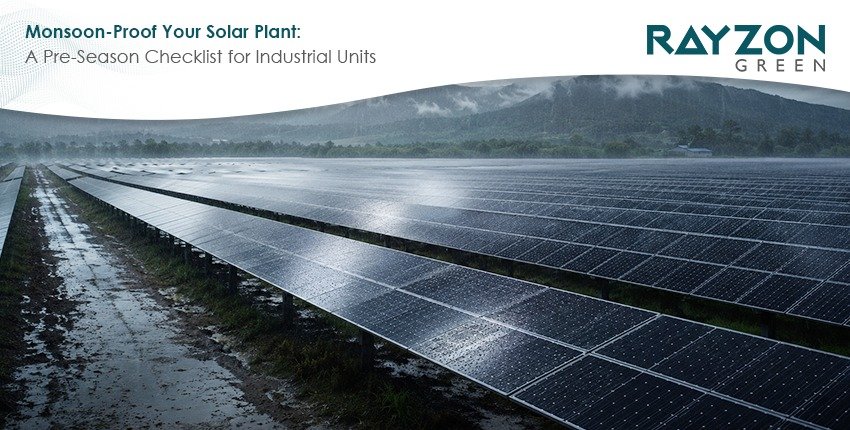
The clouds are coming. Here's everything your plant manager needs to do before they arrive — so your solar asset keeps working hard even when the sky goes dark.
India's monsoon season doesn't have to mean a broken solar plant or an insurance nightmare. With a structured pre-season audit covering panels, earthing, inverters, and safety systems, your industrial solar asset can weather June through September with minimal generation loss and zero unplanned downtime. This checklist tells you exactly what to inspect, what to fix, and when to call your EPC partner.
The first heavy spell of the monsoon has just rolled through Surat. Your plant manager calls to say the combiner box is tripping and you're not exporting to the grid. The inverter alarm is blinking red. And somewhere on the rooftop, a panel junction box is full of water.
Now the real cost isn't just the lost generation. It's the emergency service call, the weekend technician rates, the potential insurance complication, and the production line that just lost backup power.
Here's the thing — every single one of those problems was preventable. And it takes just one properly scheduled pre-monsoon audit to avoid the whole drama.
India's industrial solar belt — Gujarat, Maharashtra, Rajasthan, Telangana — sees its most demanding weather between June and September. We're talking about a combination of factors that most solar plants simply weren't stress-tested for during commissioning:
85%+ - Relative humidity during monsoon in coastal Gujarat
60–80km/h - wind gusts in a typical monsoon storm
15–25% - Avg. generation drop if plant is not pre-season serviced
Moisture infiltrates poorly sealed junction boxes. Wind lifts loose mounting clamps. Earthing systems that were "good enough" in dry season suddenly fail when soil resistance drops with the rain. And lightning — especially in Saurashtra and Vidarbha corridors — turns an unprotected string inverter into a ₹3–5 lakh replacement cost overnight.
Work through this list with your O&M team. Each item has a "do it yourself" element and a "call the experts" threshold. Be honest about which is which.
Walk every row. Look for micro-cracks, delamination, discoloured cells, and loose frame edges. Check mounting clamp torque — wind uplift during a heavy monsoon storm can dislodge panels that were "finger-tight" during installation. Any panel showing physical damage should be flagged for thermal imaging before sealing.
This is the most common and most preventable failure point. Check every junction box for IP rating compliance — they should be IP65 or higher. Re-seal any box where the gasket has dried out or the conduit entry is cracked. MC4 connectors should be properly mated and locked — moisture in a DC connector means arc faults, and arc faults mean fires.
Run a proper earth continuity test on every module frame, mounting structure, inverter chassis, and combiner box. In many older installations across Saurashtra and Marathwada, earthing electrodes have corroded or the bonding conductors have loosened. During heavy rain, a floating structure becomes a serious personnel safety hazard. Acceptable earth resistance: below 5 ohms as per CEA guidelines.
Check the status indicators on your DC surge protection devices (SPDs) in combiner boxes — a red indicator means the varistor has already sacrificed itself in a previous surge and needs replacement. On the AC side, verify SPDs at the inverter output and at your LT panel. For plants above 500 kWp in lightning-prone zones, ensure your lightning arrester earthing is isolated from the solar system earthing to prevent back-feed damage.
Clean the inverter air filters. Check the cooling fan is running at the correct RPM (listen for unusual bearing noise). Verify the inverter room or enclosure has proper drainage — standing water near inverter bases is a safety shutdown waiting to happen. Download and review the last 90 days of inverter logs: look for unexpected shutdowns, grid fault codes, and insulation resistance alarms (IRF faults are a key pre-monsoon warning sign).
For rooftop plants: walk the roof after a test with a hosepipe and watch where water pools. Ponding water under panel rows accelerates frame corrosion, stresses the roofing membrane, and in worst cases adds structural load. Clear all drains and scuppers. For ground-mount plants, check cable trenching — blocked or collapsed cable ducts in waterlogged soil are one of the leading causes of insulation faults in monsoon season.
Your plant monitoring system is your early warning system during monsoon. Test every communication link — especially if you use GSM/4G dongles that may be affected by network congestion during storms. Configure alerts for: string-level underperformance, inverter isolation faults, and generation falling below 30% of irradiance-adjusted baseline. If your plant doesn't have string-level monitoring, this is the time to ask your EPC partner about retrofitting it.
Who do you call at 11 PM when your inverter goes offline during a storm? Make sure your O&M contract has a clear monsoon-season response SLA — 4 hours for critical faults, 24 hours for non-critical. Verify your insurance policy covers "Act of God" events including wind and flood damage, and that your insurer has current plant documentation (as-built drawings, performance baseline). A claim with no baseline data is a claim that gets disputed.
Most teams clean and reseal junction boxes without running a thermal scan first. A cracked cell or a loose string connector that's already heating up will fail catastrophically inside a freshly sealed, moisture-proof box during peak summer in August. Thermal imaging in May — when irradiance is high — catches these hot spots before you seal them in.
IR testing takes about 2–3 hours for a 1 MW plant. It's not glamorous. But it finds the cables where insulation has been slowly degrading under UV exposure, heat cycling, or rodent damage. A string with poor insulation resistance doesn't fail immediately — it waits for the first heavy rain when moisture finally bridges the gap, and then it trips your inverter at the worst possible moment. Test DC cables at 1000V DC with your megger, and flag any string below 40 MΩ for replacement before monsoon.
3. Reviewing the entire 3 years of inverter fault history
Most plant managers look at last month's data. A smarter approach is to pull 36 months of fault logs and look for any fault code that appeared once and then was "cleared." Intermittent faults are pre-failure signatures. An IGBT temperature warning that appeared in August two years ago and never came back is not resolved — it's a fault waiting for the right conditions to return. Your EPC partner's O&M team can help you read the patterns.
Under the CEA (Measures Relating to Safety and Electric Supply) Regulations 2010, the principal employer — that's you, the plant owner — is responsible for maintaining the electrical installation in safe condition. A monsoon-season accident on a poorly maintained solar plant is not just an insurance issue. It can trigger regulatory inspection and in severe cases, criminal liability under the Electricity Act 2003. This checklist isn't just good practice — it's your compliance baseline.
When Rayzon Green's O&M team conducts a pre-monsoon audit on an industrial plant, we work through a structured 3-day process that covers every item above and produces a written audit report with photographic evidence, fault severity ratings, and a prioritised remediation plan.
For plants under our long-term O&M contracts, this is scheduled automatically — no follow-up calls needed, no chasing vendors, no wondering if it got done. You receive the audit report, sign off on the remediation items, and your plant is certified monsoon-ready before the first clouds build over the Western Ghats.
For plants currently with other O&M providers — or plants without any formal O&M contract — we offer a standalone pre-monsoon inspection for industrial plants above 200 kWp. Our team is currently booking for the second and third week of June across Gujarat and Maharashtra.
For a well-maintained plant in Gujarat, expect 18–28% lower monthly generation in July and August versus April–May peak. This is normal and is driven by diffuse irradiance from cloud cover, not by any failure. A plant that hasn't been pre-season serviced can lose an additional 10–15% on top of this — that's the avoidable part.
Yes — one thorough cleaning before the onset is valuable. Post-monsoon cleaning in October is even more important, as dust, soot, and biological matter deposited on panels after rains tends to be stickier and harder to remove. Don't expect rain to clean your panels for you; the soiling pattern after light rain on dusty panels is actually worse than dry soiling.
Workmanship warranties typically cover defects in installation — not damage caused by weather events. However, if damage occurs because of poor workmanship (e.g., an improperly torqued mounting clamp, an unsealed conduit entry), you may have a valid warranty claim. Document everything with photographs and timestamps before and after any weather event. Don't repair first and claim later — insurers and warranty providers require pre-repair documentation.
Items 1 and 6 (visual inspection and drainage) can be done by your facility maintenance team. Items 3, 4, and 5 require a licensed electrical contractor or your O&M partner — earthing testing and SPD replacement are not DIY tasks on a live HT-connected solar system. Items 2, 7, and 8 sit in the middle: competent in-house teams can handle them, but a professional audit adds documentation value for insurance and compliance purposes.
Rayzon Green's pre-monsoon audit service is now open for industrial plants across Gujarat and Maharashtra. Slots for June are filling fast — book your inspection before the season starts.