
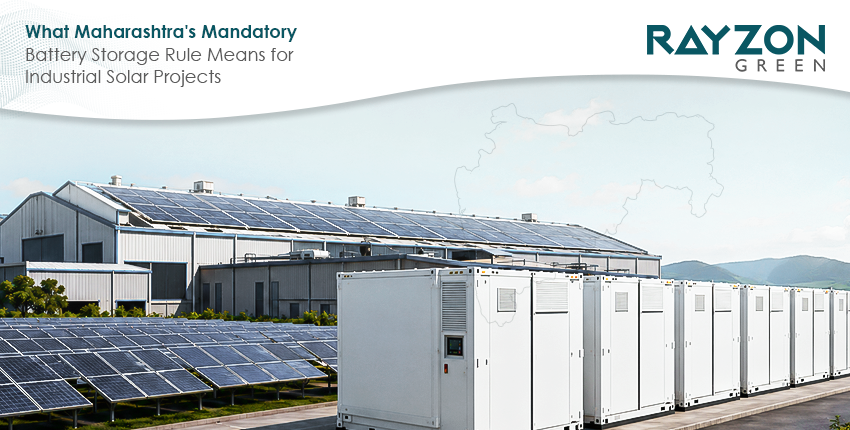
Maharashtra has just become the first Indian state to make battery energy storage systems (BESS) mandatory for commercial and industrial solar projects. Notified on March 18, 2026, this landmark policy establishes Maharashtra as India's first state to mandate energy storage as a core requirement for renewable energy integration, fundamentally transforming how businesses approach solar investments.
For industries planning solar installations in Maharashtra, this isn't just another regulatory checkbox—it's a strategic inflection point that will define the economics, resilience, and competitive positioning of your energy infrastructure for the next decade.
From April 1, 2026, all new renewable energy projects above 100 kW will be required to integrate storage capacity, initially set at 50% of project capacity for at least two hours. Let's break down what this means in practical terms.
For a 1 MW rooftop solar installation, you now need:
- 500 kWh of battery storage (50% of capacity)
- Minimum 2-hour discharge duration through 2030
- 4-hour discharge duration from FY 2030-31 onwards
- New rooftop solar systems above 100 kW
- Open access and captive renewable energy projects
- Grid-interactive solar installations
- Industrial, commercial, and MSME facilities
What about existing solar projects? They're encouraged but not mandated to add storage. However, as we'll explore, there are compelling financial reasons to consider retrofitting.
Why Maharashtra Made This Bold Move
This policy didn't emerge in a vacuum. Maharashtra is addressing a fundamental challenge that every high-renewable-penetration grid faces: the duck curve.
Solar generation peaks during midday when industrial demand may be moderate, then plummets in the evening just as factories, offices, and homes ramp up consumption. Without storage, this mismatch forces grid operators to maintain expensive fossil-fuel backup capacity and sometimes curtail renewable generation when supply exceeds demand.
The policy outlines a vision to position Maharashtra as a national and Asian frontrunner in renewable energy and storage over the next decade, aiming to procure 65% of its electricity from renewable sources and ensure that at least 10% of the power demand is supported by energy storage systems by 2035.
Grid stability: Batteries absorb excess solar generation during peak production hours and discharge during evening peak demand, smoothing supply-demand fluctuations.
Firm renewable power:Storage transforms intermittent solar into dispatchable, reliable power that industries can count on regardless of weather or time of day.
Reduced grid congestion: Localized storage near consumption centers reduces transmission bottlenecks and line losses.
Accelerated decarbonization: By making renewable energy more reliable, storage enables higher penetration rates than would be possible with solar alone.
Let's address battery storage adds significant upfront cost to solar projects.
For factories and plants in Maharashtra planning 1 MW+ rooftop solar in 2026-27, the practical impact is a 15-22% increase in upfront cost, approximately ₹50-65 lakh per MW for a 500 kWh / 2-hour Li-ion BESS.
For context, if your 1 MW solar installation costs ₹4-4.5 crore, you're now looking at an additional ₹50-65 lakh for the required battery system. That's substantial—but it's only half the story.
While the initial investment increases, so does the value proposition. Solar-plus-storage delivers multiple revenue streams and cost savings that standalone solar cannot:
The storage system unlocks Time-of-Day arbitrage worth ₹1.50-2.20/kWh on industrial tariffs. By storing solar energy during low-rate midday periods and using it during expensive peak hours, you avoid the highest electricity costs.
For a facility consuming 500 kWh daily during peak hours, shifting that consumption to stored solar can save ₹2.75-11 lakh monthly, depending on your tariff structure.
Industrial and commercial tariffs include hefty demand charges based on your maximum power draw in a billing period. By using batteries to "peak shave"—reducing your maximum grid draw—you can cut demand charges by 20-40%. For large facilities, this alone can justify the storage investment.
Battery systems provide instantaneous backup during grid outages, eliminating the lag time, noise, and emissions of diesel generators. For industries where even brief outages cause production losses, equipment damage, or safety issues, this reliability has tangible value that often exceeds the direct energy savings.
For captive renewable energy installations combined with BESS, the state offers a 10-year electricity duty holiday under its 2026 RE policy. This exemption, combined with accelerated depreciation benefits for energy storage assets, meaningfully improves project economics.
Storage support will be provided to MSMEs under the policy by purchasing Battery Energy Storage Systems on a large scale, suggesting additional procurement support that could reduce acquisition costs for smaller enterprises.
Forward-thinking businesses will recognize that this mandate creates opportunities beyond mere regulatory compliance.
Solar-plus-storage fundamentally changes your relationship with the grid. Instead of being a passive consumer subject to utility rates and reliability, you gain active control over your energy supply. You can optimize consumption patterns to align with production schedules rather than grid constraints, shifting energy-intensive processes to times when your stored solar power is available.
Companies with net-zero commitments will find that integrated storage accelerates decarbonization. Solar-only systems typically provide 30-40% of a facility's annual energy needs due to timing mismatches. Solar-plus-storage can push that renewable utilization rate to 70-85%, dramatically reducing Scope 2 emissions and enhancing ESG reporting.
Future-Proofing Against Grid Evolution
Maharashtra's policy is likely just the beginning. As renewable penetration increases nationwide, similar mandates will emerge in other states. Distribution companies across Maharashtra must now procure storage equivalent to at least 10% of their peak demand by 2035, creating a grid increasingly designed around storage-backed renewable energy.
Businesses that integrate storage now position themselves ahead of this curve, gaining experience with optimization strategies and benefiting from early-mover advantages in understanding how to maximize the value of these systems.
Successfully implementing a solar-plus-storage system requires careful planning across multiple dimensions.
1. Right-Size Your System Through Load Analysis
Generic sizing formulas won't optimize your investment. You need detailed analysis of:
- Your load profile throughout the day and across seasons
- Peak demand windows and their duration
- Production schedules and their flexibility
- Current electricity costs by time-of-use period
- Historical outage patterns and their business impact
This analysis determines whether you need more or less than the minimum mandated storage and helps optimize the discharge duration and power rating.
Lithium-ion dominates the market for good reasons—high energy density, declining costs, and mature supply chains—but alternatives merit consideration for specific applications:
Lithium Iron Phosphate (LFP): Safer chemistry with longer cycle life, ideal for stationary storage. Slightly lower energy density than NMC but better thermal stability and 4,000-6,000+ cycle life.
Lithium Nickel Manganese Cobalt (NMC): Higher energy density, good for space-constrained installations. Cycle life around 3,000-4,000 cycles.
Advanced Lead-Acid:Lower upfront cost but shorter lifespan and lower depth of discharge. May suit applications with infrequent cycling or very tight initial budgets.
The choice depends on your duty cycle, available space, maintenance capabilities, and total cost of ownership over the system's lifetime, not just initial cost.
Battery costs continue falling—lithium-ion prices have dropped over 80% in the past decade and show no signs of plateauing. Solar costs follow a similar trajectory. Design your electrical infrastructure, inverters, and control systems with headroom for capacity expansion.
Installing 500 kWh now but designing switchgear and controls for 1 MWh future capacity costs marginally more upfront but avoids expensive retrofits later when your energy needs or economics justify expansion.
The value of storage multiplies when paired with intelligent control systems. Modern energy management platforms use AI and machine learning to:
- Forecast solar generation based on weather data
- Predict your facility's load patterns
- Optimize battery charging/discharging schedules
- Respond to time-of-use pricing signals automatically
- Participate in demand response programs
These systems transform static infrastructure into a dynamic asset that continuously optimizes itself for maximum economic value.
Solar-plus-storage systems are complex, involving photovoltaics, battery chemistry, power electronics, thermal management, software controls, and grid interconnection requirements. The integration matters as much as the components.
Choose partners with proven track records delivering complete renewable energy solutions, not just solar panel installers learning battery systems on the fly. Experience with Maharashtra's regulatory environment, MSEDCL interconnection procedures, and MERC compliance requirements is essential.
If you already have a solar installation, you're not legally required to add storage—but the economics may compel you to consider it anyway.
Maharashtra's net metering and banking regulations have evolved. With Time-of-Day tariffs now in effect across most commercial and industrial categories, the value you receive for excess solar exported to the grid during midday is significantly less than what you pay for grid electricity during evening peak hours.
The financial model needs to account for same-slot settlement, the ToD premium on peak-hour grid draw, the Grid Support Charge that now applies since Maharashtra's rooftop solar capacity has crossed the threshold that triggers it, and the mandatory storage requirement for new projects.
Adding a battery system to an existing solar plant allows you to recapture the peak-hour advantage that the new banking rules have removed. The cost of retrofitting depends on battery size, chemistry, and site configuration.
For a 500 kW existing solar system, adding 250-500 kWh of storage (½ to 1 hour at full capacity) might cost ₹25-50 lakh but could improve your overall energy savings by 30-50% compared to solar-only operation under current tariff structures.
The Bigger Picture: Maharashtra's Energy Future
This policy positions Maharashtra at the forefront of India's energy transition. By 2035, the state aims for:
- 65% renewable energy in total electricity demand
- 00 GWh of cumulative storage capacity
- 10% of peak demand supported by energy storage
- 15+ Renewable Energy Industrial Zones of 100 MW or more each
The state plans to develop at least 15 Renewable Energy Industrial Zones (REIZs) of 100 MW or more each by 2035-36, while offering incentives such as ₹0.5 per kWh for wind repowering projects and prioritizing hybrid renewable projects integrating wind, solar, and storage.
For industries, this represents a fundamental transformation in how energy infrastructure is conceived and operated. The businesses that adapt quickly—seeing storage not as a compliance burden but as a strategic enabler—will capture competitive advantages through:
- Lower total energy costs via time-of-use optimization and demand charge management
- Superior reliability that eliminates costly production disruptions
- Enhanced sustainability credentials that meet stakeholder and customer expectations
- Future-ready infrastructure aligned with India's inevitable energy transition
Understanding the rollout timeline helps with planning:
- April 1, 2026: Storage mandate takes effect for new projects >100 kW
- FY 2030-31: Minimum storage duration increases from 2 hours to 4 hours
- FY 2035-36: DISCOMs must have storage equal to 10% of peak demand
If you're planning a solar project in the near term, starting now gives you time to:
- Conduct thorough feasibility studies
- Secure financing that accounts for storage costs
- Design systems optimally rather than rushing to meet deadlines
- Lock in current equipment prices before potential increases
No. While storage adds 15-22% to upfront costs, it unlocks value streams that improve overall returns. Multiple analyses show solar-plus-storage achieving 12-18% IRR in Maharashtra's industrial sector, comparable to or better than solar-only projects were achieving previously.
Modern lithium-ion batteries retain 80%+ capacity after 3,000-6,000 cycles (8-15 years of daily cycling). Factor ₹15-25 lakh per MWh for eventual replacement, but warranty coverage often extends 10 years. Proper thermal management and operating batteries within optimal state-of-charge windows significantly extends lifespan.
Maharashtra is the first, but unlikely to be the last. States like Gujarat, Tamil Nadu, and Karnataka are studying similar mandates. The central government's push toward 500 GW of renewable capacity by 2030 inherently requires massive storage deployment. Early movers in Maharashtra gain experience that will translate to advantages when other markets evolve similarly.
The policy requires integrated systems from April 2026 onward. However, you can design for future expansion—installing 50% capacity now with infrastructure to add more later as needs grow or economics improve.
Maharashtra's mandate isn't just state policy—it's a blueprint for India's renewable energy future. As the country's second-largest electricity consumer and industrial powerhouse, what works in Maharashtra will inform national strategies.
The policy demonstrates that high renewable penetration doesn't require sacrificing reliability or grid stability. It proves that storage, once seen as a future technology, is commercially viable today when properly valued for the multiple services it provides.
For the solar industry, this marks evolution from a commodity product (solar panels) to integrated energy solutions. Success now requires expertise spanning multiple technologies and the ability to optimize complex systems for site-specific conditions.
At Rayzon Green, we recognize that Maharashtra's storage mandate represents both a challenge and an opportunity. We've been preparing for this transition, developing integrated solar-plus-storage solutions specifically designed for industrial and commercial applications.
- Detailed load profiling and system sizing analysis
- Technology selection optimized for your specific duty cycle
- Complete electrical, civil, and structural design
- Grid interconnection and MERC compliance management
- Accurate ROI projections accounting for all value streams
- Subsidy and incentive identification and application support
- Multiple financing options including OPEX and CAPEX models
- Life-cycle cost analysis including maintenance and eventual replacement
- Procurement of best-in-class solar and storage equipment
- Complete installation with minimal operational disruption
- Commissioning and grid synchronization
- Staff training on system operation and monitoring
- Advanced energy management system integration
- Real-time monitoring and predictive maintenance
- Performance optimization based on actual operational data
- Comprehensive O&M services to protect your investment
Rayzon Green has delivered numerous commercial and industrial solar projects across Maharashtra and understands the state's regulatory environment, utility interconnection procedures, and industrial energy requirements intimately.
Maharashtra's storage mandate isn't a distant regulatory requirement—it's effective now for new projects. Whether you're planning a new solar installation or considering retrofitting an existing system, early action gives you the most options and the best outcomes.
Our team can help you:
- Assess whether solar-plus-storage makes economic sense for your facility
- Design a system optimized for your specific energy profile and business needs
- Navigate the regulatory landscape and secure necessary approvals
- Implement a turnkey solution that delivers reliable, cost-effective clean energy
The energy landscape is shifting. The businesses that adapt strategically today will lead their industries tomorrow.
Let's discuss how integrated solar-plus-storage can enhance your facility's energy resilience, reduce costs, and position your business at the forefront of India's clean energy future.
Get in touch with our renewable energy experts
Visit: www.rayzongreen.com
Email: info@rayzongreen.com
Rayzon Green - Powering India's Sustainable Industrial Future
About Rayzon Green
Rayzon Green is a leading solar solutions provider specializing in large-scale commercial and industrial renewable energy projects. With extensive experience across Maharashtra's industrial sector, we deliver end-to-end solar and energy storage solutions that combine technical excellence with financial optimization. Our mission is to make clean, reliable, cost-effective energy accessible to India's industrial backbone, driving both environmental sustainability and business competitiveness.