

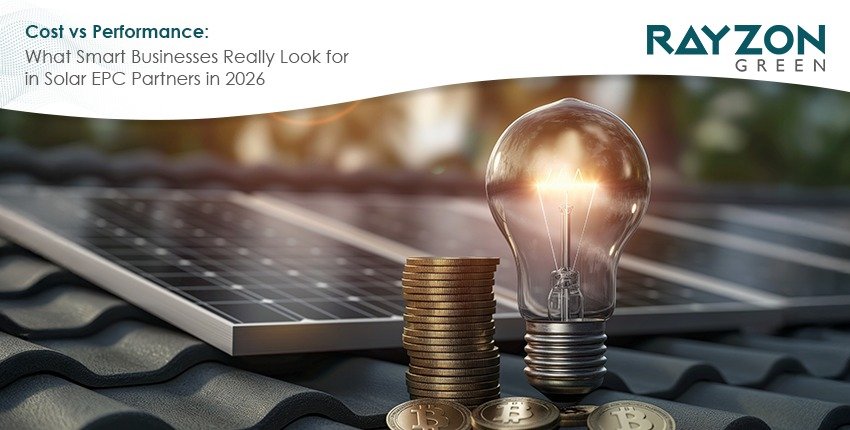
For years, the solar industry - especially in the C&I (Commercial & Industrial) segment—has been driven by one dominant question:
But in 2026, that question is rapidly being replaced by a smarter one:
As energy demands rise and margins tighten, businesses are realizing that solar is no longer just a cost-saving tool—it’s a strategic asset. And like any asset, its value is determined not by how cheap it is upfront, but by how well it performs over time.
This shift is redefining how companies choose their Solar EPC (Engineering, Procurement, and Construction) partners.
At first glance, a lower project cost seems like a win. But many businesses learn the hard way that cutting corners upfront often leads to higher costs later.
Component quality: Switching premium solar panels for lower-tier modules that degrade faster
Design optimization: Cookie-cutter designs that ignore site-specific shading, orientation, or structural issues
Installation standards:Rushed work, undertrained crews, or non-compliant electrical installations
Post-installation support:Vanishing act after commissioning when you need them most
In short:
You may save 5–10% initially, but lose 20–30% in performance over the system’s lifetime.
In 2026, forward-thinking businesses are evaluating solar projects based on lifecycle performance, not just installation cost. When evaluating solar EPC partners , performance isn't just about wattage output or efficiency percentages. Smart businesses are looking at a comprehensive performance matrix that determines long-term ROI.
How much electricity does the system actually produce vs projected output?
Does the plant maintain consistent performance over years?
How quickly do panels lose efficiency over time?
How fast are issues detected and resolved?
How quickly does the system recover its cost—and how much does it earn afterward?
Solar isn’t just about placing panels on a roof—it’s about precision engineering.
Smart businesses ask:
A well-engineered system can outperform a standard installation by a significant margin.
In 2026, it’s not about choosing “any Tier-1 brand”—it’s about selecting the right components for your specific use case.
Key considerations:
Because even the best design can fail with poor components.
Modern solar plants are becoming intelligent systems.
Smart EPC partners provide:
This allows businesses to:
Many EPC providers focus only on project execution.
But smart businesses look for partners who stay beyond commissioning.
This includes:
Because solar is a 25+ year asset, not a one-time project.
In 2026, performance guarantees are becoming a key differentiator.
Businesses now expect:
This shifts the relationship from vendor-based to performance partnership.
Let’s be clear—cost still matters.
But the smartest businesses don’t ignore cost—they contextualize it
“Which EPC is cheapest?”
“Which EPC delivers the highest return over 25 years?”
A Simple Comparison:
|
Factor |
Low-Cost EPC |
Performance-Driven EPC |
|
Initial Investment |
Lower |
Slightly Higher |
|
Energy Output |
Moderate |
Optimized |
|
Maintenance Costs |
Higher |
Lower |
|
System Lifespan Efficiency |
Declines faster |
Sustained performance |
|
ROI |
Slower |
Faster & Higher |
When evaluating solar EPC partners this year, here's what forward-thinking businesses prioritize:
Financial Stability
Businesses are increasingly preferring EPCs who commit to output-based agreements.
2. Integration of Smart Technologies
AI-driven monitoring and analytics are becoming standard.
One-size-fits-all solar solutions are being replaced by site-specific engineering.
4. Focus on Sustainability Metrics>
Beyond cost savings, companies are tracking carbon reduction and ESG impact.
At Rayzon Green, the focus goes beyond installation.
The approach is built on one core belief:
This translates into:
Because for businesses, solar isn’t just about saving money—
it’s about building a reliable, high-performing energy asset.
In 2026, the solar conversation has matured.
Businesses are no longer asking:
“How cheap can we go?”
They’re asking:
“How much value can we create?”
And the answer lies in choosing the right EPC partner—one that prioritizes performance, reliability, and long-term returns.
Because in the end:
The real cost of solar isn’t what you pay upfront—
it’s what you lose if your system underperforms.
Performance is more important in the long run, as it directly impacts energy generation, ROI, and system reliability.
Evaluate their engineering expertise, component quality, monitoring capabilities, and lifecycle support—not just pricing.
Not always, but performance-driven EPCs typically deliver better long-term value through optimized design and quality execution.
Typically 3–5 years, depending on system performance and energy usage patterns.