

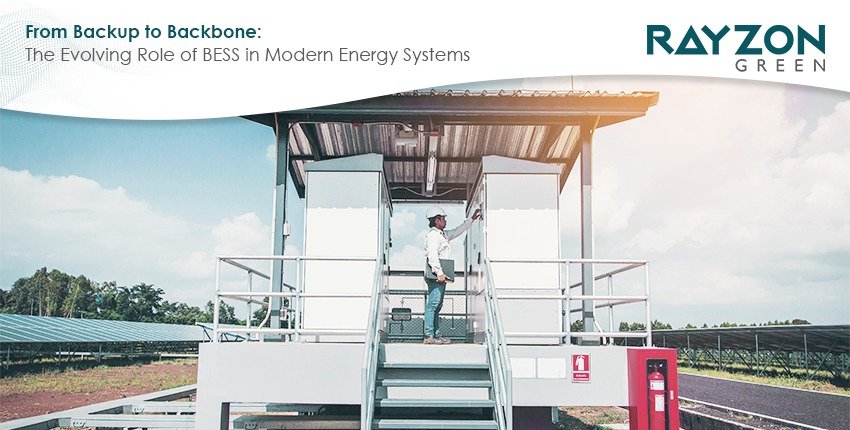
Not long ago, Battery Energy Storage Systems (BESS) were seen as a safety net—a backup plan for when the grid failed or solar panels went quiet. Today, that perception is rapidly changing. BESS is no longer just a contingency solution; it is becoming the central pillar of modern energy systems—a true backbone that enables reliability, flexibility, and smarter energy use.
At Rayzon Green, this shift is not just observed—it’s actively engineered into every solution.
Traditional energy systems followed a simple rule: generate power when needed. But renewable energy—especially solar—doesn’t always align with demand. The sun shines during the day, while consumption often peaks in the evening.
This is where BESS steps in—not just to store excess energy, but to actively manage when and how energy is used.
Instead of sitting idle, modern BESS:
It transforms energy from a fixed supply model into a dynamic, intelligent ecosystem.
To truly understand the impact of BESS, it helps to compare how its role has evolved:
|
Aspect |
Traditional Backup Systems |
Modern BESS (Backbone Role) |
|
Purpose |
Emergency power only |
Continuous energy optimization |
|
Usage |
Rare, during outages |
Daily charge & discharge cycles |
|
Energy Source |
Diesel generators / grid |
Solar + renewable integration |
|
Cost Impact |
High operating cost |
Reduces electricity bills |
|
Response Time |
Delayed start |
Instant activation |
|
Environmental Impact |
High emissions |
Clean, zero-emission operation |
|
Intelligence |
Manual / limited control |
Smart, automated energy management |
|
Grid Interaction |
Isolated |
Supports and stabilizes grid |
This shift shows how BESS has moved from being a passive asset to an active energy controller.
At its heart, BESS solves a simple but critical equation:
Estored =Egenerated−Econsumed
(E_{stored} = E_{generated} - E_{consumed})
This equation highlights a powerful idea: instead of wasting excess generation, energy can be captured, stored, and redeployed exactly when required.
For businesses and industries, this means:
Earlier, backup systems were considered an expense—a necessary cost for reliability. BESS flips that narrative.
With intelligent energy storage, businesses can:
A simplified savings perspective:
Savings=(Peak Tariff−Off-Peak Tariff)×Energy Shifted
This means the more effectively energy is stored and shifted, the greater the financial return.
Let’s consider a simplified real-world scenario for a commercial facility:
|
Parameter |
Without BESS |
With BESS |
|
Solar Utilization |
~60–70% |
~90–95% |
|
Peak Hour Grid Usage |
High |
Significantly reduced |
|
Electricity Cost |
Higher due to peak tariffs |
Lower via energy shifting |
|
Power Backup |
Limited / diesel dependent |
Instant & reliable |
|
Downtime Risk |
Moderate to high |
Minimal |
|
Carbon Footprint |
Higher |
Substantially reduced |
BESS doesn’t just store power—it creates financial value.
A simple way to understand savings:
Savings=(Peak Tariff−Off-Peak Tariff)×Energy Shifted
Over a year, this becomes a significant cost advantage
In industrial environments, even a short outage can lead to:
BESS ensures uninterrupted operations by acting as an instant response system. Unlike traditional generators, it:
For industries aiming for both efficiency and sustainability, BESS is no longer optional—it’s essential.
Renewable energy adoption is accelerating, but without storage, its full potential remains untapped. BESS enables:
In simple terms, solar generates the energy, but BESS ensures it’s usable—anytime, anywhere.
Modern energy systems are evolving into smart grids, where energy flows are optimized in real time. BESS plays a critical role by:
This transforms energy infrastructure from rigid and centralized to flexible and adaptive.
At Rayzon Green, BESS is not treated as an add-on—it is integrated as a core component of energy strategy.
The focus is on:
By combining solar expertise with advanced storage solutions, Rayzon Green ensures that energy systems are not just sustainable—but also intelligent and future-ready.
The role of BESS has fundamentally changed.
The energy landscape is changing fast. What was once considered backup is now becoming the foundation of modern power systems.
BESS is:
The future belongs to systems that are not just powered—but intelligently powered.
And BESS is leading that transformation.
A Battery Energy Storage System (BESS) stores electricity—typically from solar or the grid—and supplies it when needed, ensuring efficient and reliable energy use.
Unlike traditional backups that work only during outages, BESS operates daily—storing excess energy and using it smartly to reduce costs and improve efficiency.
BESS stores energy during low-cost periods (or from solar) and uses it during peak tariff hours, helping businesses significantly lower electricity bills.
BESS provides instant, seamless backup power, ensuring there is no interruption to critical operations.
Yes, BESS is ideal for industries and commercial spaces as it reduces downtime, manages peak demand, and improves overall energy reliability.
Absolutely. BESS offers long-term savings, energy independence, and better utilization of renewable energy, making it a smart and future-ready investment.