

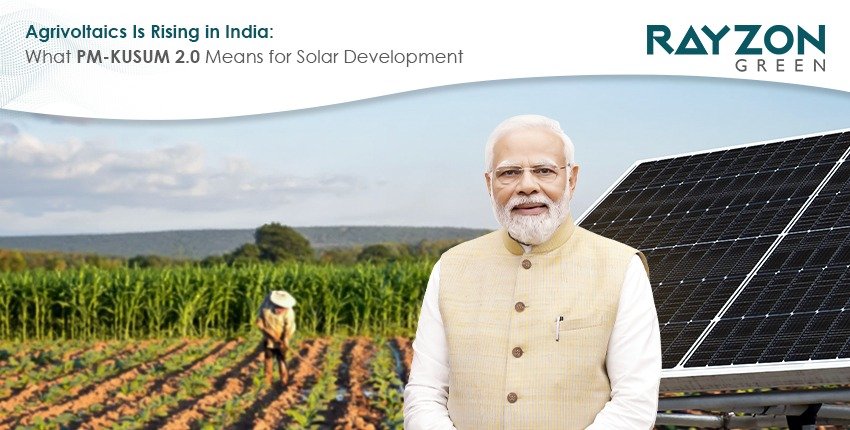
India’s renewable energy sector is entering a new phase where solar power and agriculture are beginning to work together instead of competing for land. Recent policy developments suggest that agrivoltaics—solar systems installed alongside agricultural activities—could become a major part of India’s clean energy expansion.
According to recent announcements, the government is preparing PM-KUSUM 2.0 with a dedicated 10 GW agrivoltaics component, encouraging the installation of solar panels on farmland while allowing crops to grow simultaneously.
This development signals a new opportunity for farmers, solar developers, and EPC companies to collaborate in building a more sustainable and decentralized energy ecosystem.
Agrivoltaics (also called Agri-PV) refers to the dual use of land for agriculture and solar energy generation. Instead of converting farmland exclusively for solar projects, this model enables crops and solar panels to coexist on the same land.
Typically, solar panels are mounted on elevated structures, allowing sunlight to reach crops below while still generating electricity above. The approach ensures that agricultural land remains productive while contributing to clean energy production.
This concept is gaining attention because it helps address one of the biggest challenges in solar expansion—land availability.
India’s renewable energy targets are expanding rapidly, and solar installations require significant land. Agrivoltaics offers a practical solution by ensuring that land can support multiple productive purposes at once.
Agrivoltaics allows farmland to generate both food and electricity, maximizing the value of agricultural land.
The model can create stable additional revenue streams for farmers through solar energy generation or land participation in solar projects.
Renewable energy adoption in rural areas is already helping farmers access reliable power for irrigation while lowering energy costs.
By combining agriculture and solar generation, agrivoltaics helps prevent conflicts between food production and energy development.
The government introduced the Pradhan Mantri Kisan Urja Suraksha evam Utthaan Mahabhiyan to strengthen farmers’ energy access through solar power.
The upcoming phase of the program is expected to include a 10 GW agrivoltaics component, promoting the co-location of solar panels with crops and enabling farmers to generate electricity while continuing agricultural activities
The broader goals of the initiative include:
By encouraging agrivoltaics, the program aims to strengthen the connection between rural development and renewable energy growth.
The emergence of agrivoltaics projects creates new opportunities for solar EPC companies that specialize in designing and executing renewable energy infrastructure.
Agrivoltaics systems require specialized expertise because they must balance solar efficiency with agricultural productivity.
Solar panels must be installed at appropriate heights and spacing to allow farm operations to continue smoothly.
Different crops and soil conditions require customized solar layouts, making engineering expertise essential.
Successful agrivoltaics projects must consider panel orientation, land use, irrigation systems, and farm equipment access.
Ongoing monitoring and maintenance help ensure that the system delivers consistent energy output while maintaining land usability.
As India explores new solar deployment models, companies with strong EPC capabilities will play a key role in implementing these projects.
Rayzon Green focuses on delivering solar infrastructure that balances efficiency, reliability, and sustainability. Agrivoltaics projects represent a natural extension of this vision—integrating renewable energy solutions with productive land use.
By combining advanced engineering with responsible project development, EPC providers can support solar installations that benefit both energy generation and rural livelihoods.
India’s renewable energy transition is increasingly moving toward innovative and inclusive solutions. Agrivoltaics demonstrates how solar power can expand while still supporting agriculture and rural communities.
With the upcoming expansion of the Pradhan Mantri Kisan Urja Suraksha evam Utthaan Mahabhiyan and its focus on agrivoltaics deployment, this approach could become a significant part of India’s solar development in the coming years.
For the solar industry, the message is clear: the future of renewable energy lies not only in generating power—but in using land and resources more intelligently.
Agrivoltaics is the dual use of land for agriculture and solar energy generation, where solar panels are installed above crops, allowing both farming and electricity production on the same land.
PM-KUSUM 2.0 is the upcoming phase of India’s solar initiative that aims to expand decentralized renewable energy, including a proposed 10 GW agrivoltaics component.
Agrivoltaics helps farmers earn additional income from solar power, reduces electricity costs for irrigation, and allows continued agricultural production.
Agrivoltaics helps solve land-use challenges by combining food production and solar energy generation, supporting both sustainability and renewable energy expansion.
EPC companies design, engineer, and execute agrivoltaics systems, ensuring optimal solar performance while maintaining agricultural productivity.